Why Does Your Compact HPL Warp?
Discover why Compact HPL panels warp, bow, or curl. Learn the root cause (moisture imbalance), installation mistakes, and actionable prevention tips to ensure durable, flat installations.
Why Does Your Compact HPL Warp?
You've specified Compact HPL for a commercial restroom, a laboratory worktop, or a high-traffic reception desk because you know its reputation: impact-resistant, self-supporting, and moisture-resistant. It's the material that's supposed to outperform wood-based panels in the toughest environments.
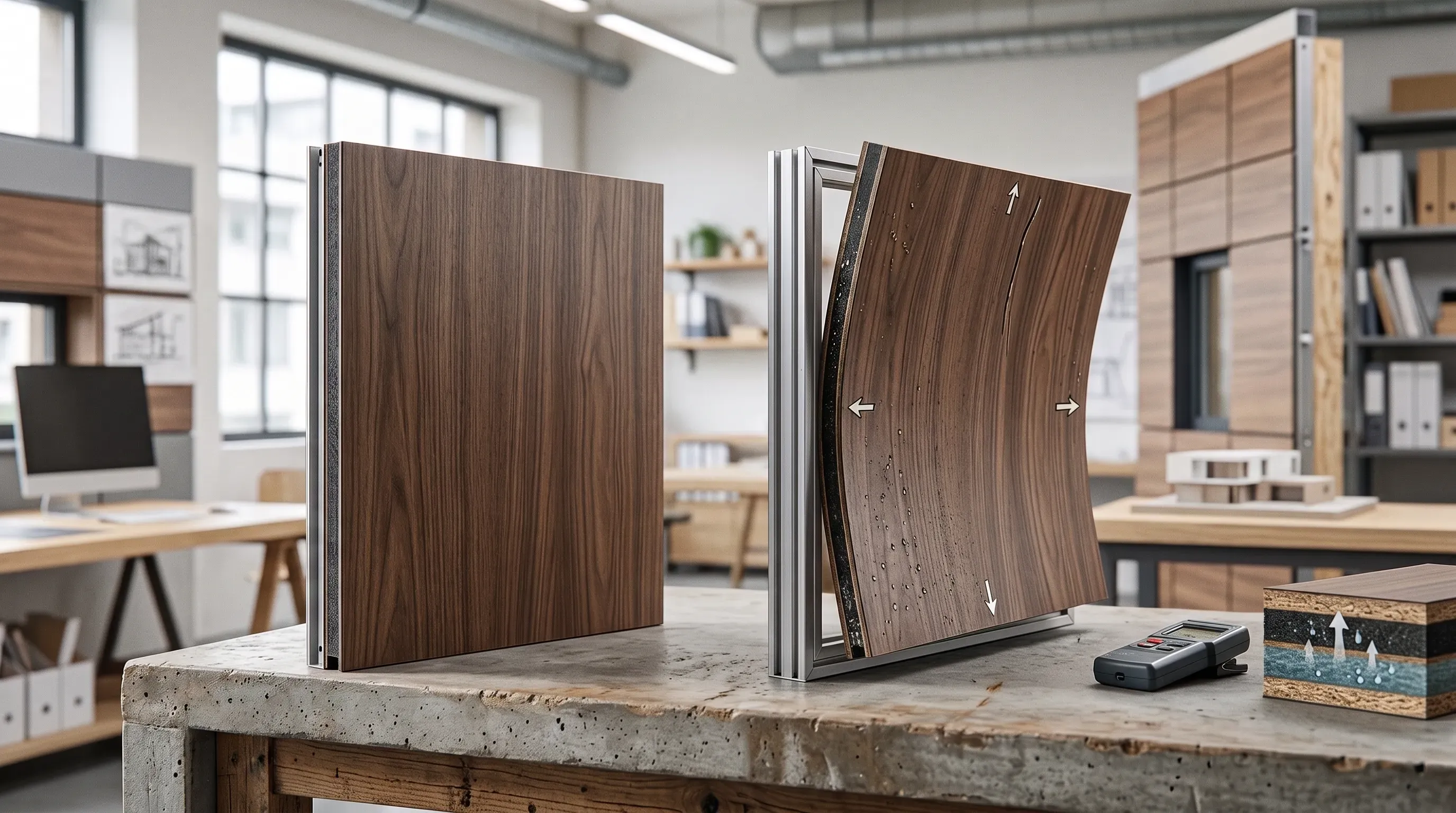
So why—despite all these guarantees—do some Compact HPL tabletops and partitions still warp, bow, or curl after installation?
The short answer is almost always uneven moisture exposure. And understanding why this happens requires a quick look at what Compact HPL actually is—and why it behaves differently from materials like solid surfacing or natural stone.
What Compact HPL Is Made Of (And Why It Matters)
Compact HPL is manufactured by saturating multiple layers of kraft paper with phenolic resin and compressing them under high temperature (approximately 150°C) and high pressure (around 1430 psi). The result is an exceptionally dense, high-strength composite board.
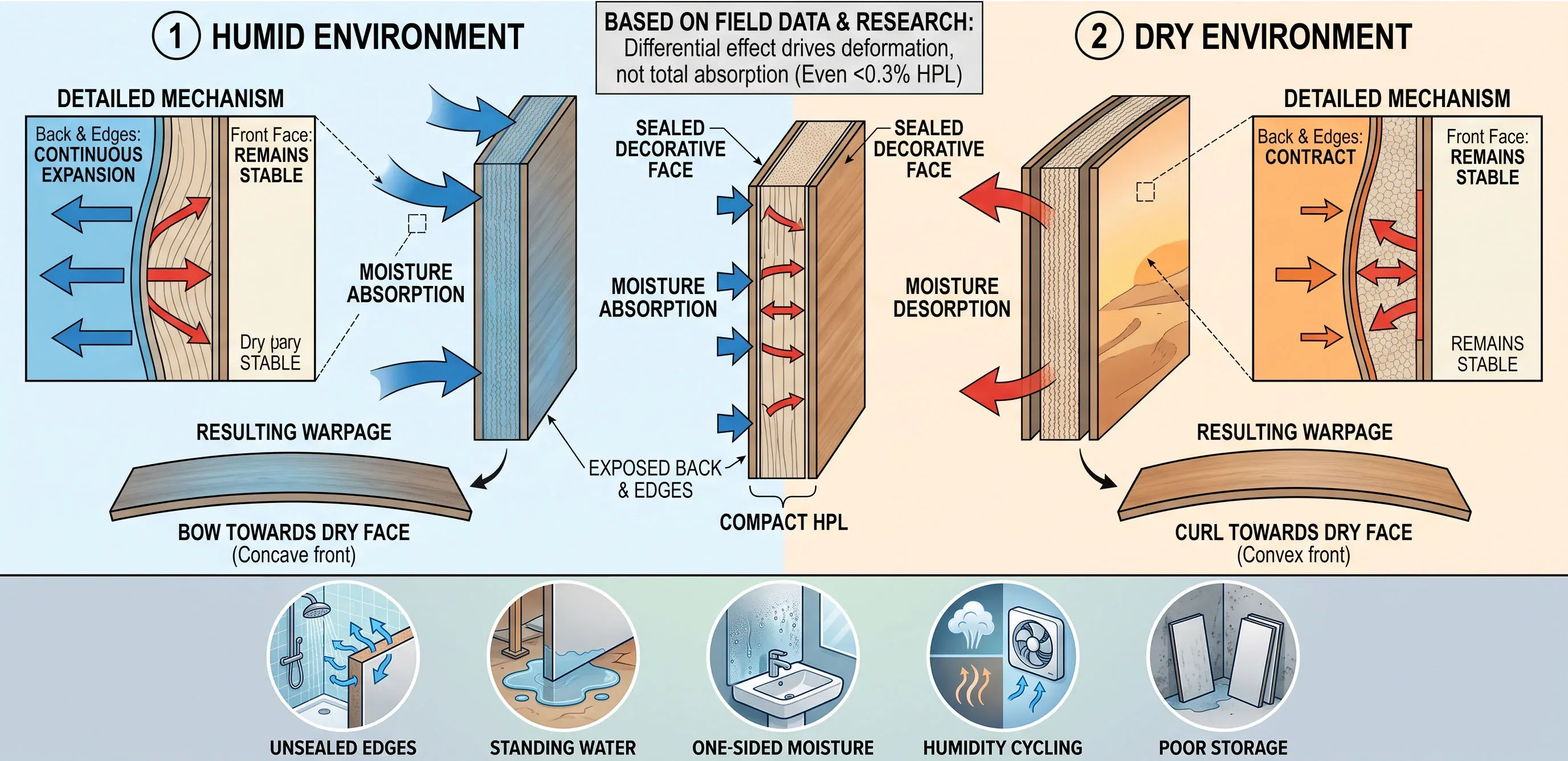
But here's the critical detail: the substrate is fundamentally paper fiber. The decorative face is sealed with a melamine resin surface that is nearly impermeable to moisture. However, the cut edges, back face, and any exposed core areas remain porous and capable of absorbing or releasing moisture.
This asymmetry—a waterproof front, a breathable back and edges—is the root cause of nearly every field-instance of warping.
Moisture Imbalance (Responsible for 90% of Field Failures)
Based on field data from real engineering projects, uneven moisture absorption and desorption accounts for approximately 90% of Compact HPL warping cases. Here's the mechanism:
In a humid environment: The exposed edges and back face continuously absorb moisture and expand. The sealed front face does not. This differential expansion creates internal stress, causing the panel to bow or curl toward the dry side—typically the decorative face.
In a dry environment: The reverse occurs. The back and edges lose moisture and contract while the front face remains stable, causing the panel to warp in the opposite direction.
This isn't theoretical. Research confirms that asymmetric moisture absorption can cause significant warpage values in laminate panels. Even though Compact HPL has remarkably low water absorption—as low as 0.3% in some formulations—the differential effect, not the total absorption, is what drives deformation.
Most Common On-Site Triggers:
- Panels installed with edges left unsealed in wet areas
- Direct contact with standing water on floors during construction
- One side of the panel exposed to continuous moisture (e.g., behind a sink) while the other remains dry
- Rapid humidity cycling in spaces like bathrooms with poor ventilation
- Panels stored vertically against damp walls or directly on concrete floors
The Second Tier: Residual Stress and Installation Errors
While moisture imbalance is the primary culprit, two other factors frequently contribute:
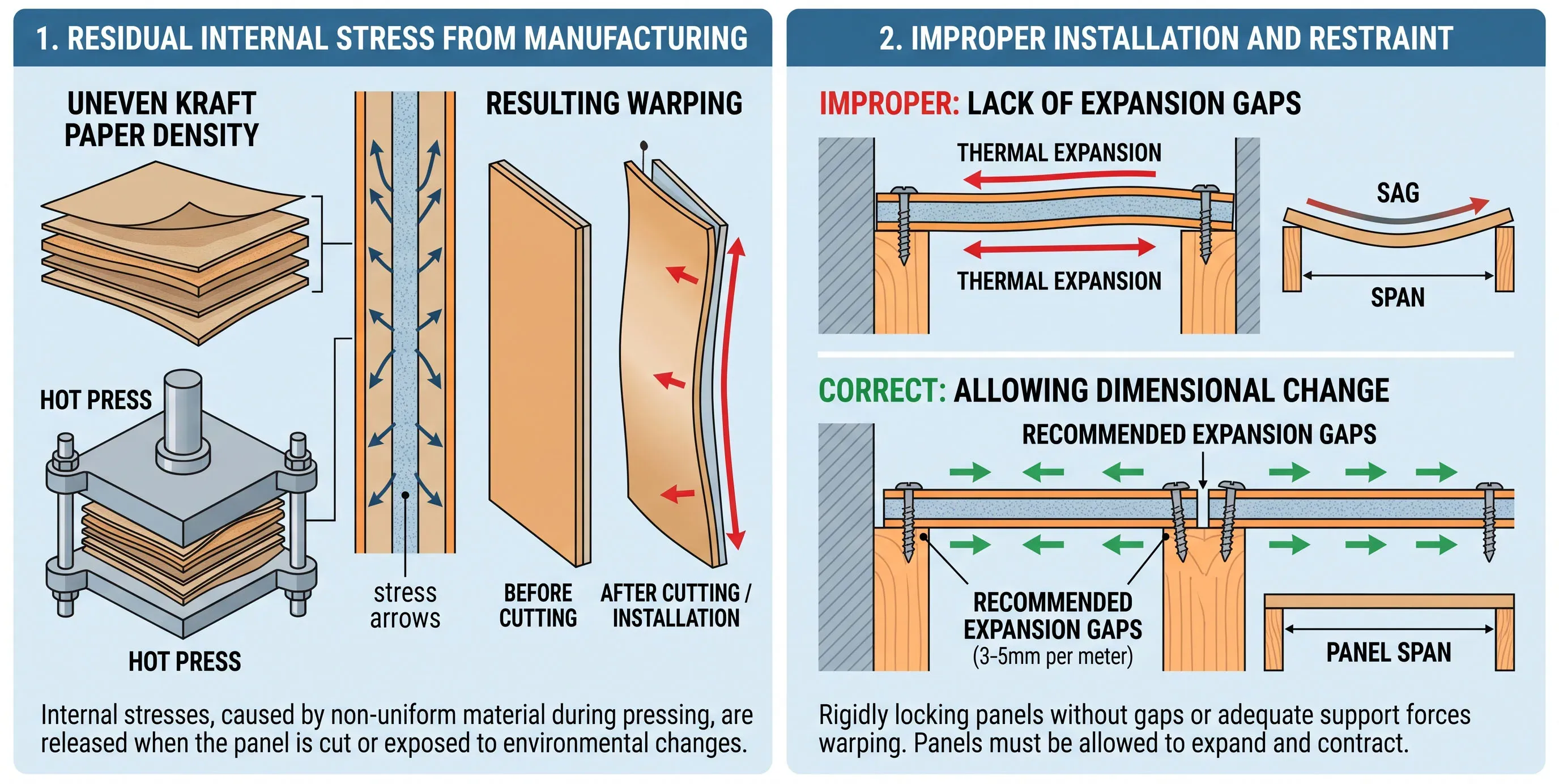
1. Residual Internal Stress from Manufacturing
If the base kraft papers used in production lack uniform thickness, density, or composition, the panel can retain internal stress from the pressing process. This stress may not manifest until the panel is cut, installed, or exposed to environmental changes.
2. Improper Installation and Restraint
Locking panels down rigidly without allowing for natural expansion and contraction—or failing to provide adequate support for large spans—can force warping that would otherwise be negligible. Thermal expansion gaps of approximately 3–5mm per meter of panel length are typically recommended to accommodate dimensional changes.
Prevention: What Works
The good news is that Compact HPL warping is entirely preventable with proper handling and installation protocols:
Storage:
Always store Compact HPL panels horizontally on a flat, level surface. Vertical storage against walls creates uneven stress and increases the risk of bowing. Protect panels from moisture and never store them in direct contact with floors or exterior walls.
Edge Sealing:
In wet applications, seal all cut edges with an appropriate edge banding or waterproof sealant. This prevents moisture ingress through the most vulnerable pathways.
Substrate and Support:
Ensure the underlying structure is flat, dry, and provides uniform support. For thicknesses over 6mm, Compact HPL is self-supporting, but inadequate framing can still create stress points.
Acclimatization:
Allow panels to acclimate to the installation environment before fixing. This minimizes the moisture differential between the panel and its surroundings.
The Takeaway
Compact HPL is one of the most durable and stable engineered materials available—but it is not immune to the laws of physics. When warping occurs, in the vast majority of cases, the root cause is uneven moisture exposure on one side of the panel versus the other.
Understanding this mechanism—and implementing the simple preventative measures outlined above—will ensure your Compact HPL installations remain flat, stable, and perform as specified for decades to come.