
Why Wood-Grain Tabletops Are Defining the “Quiet Cafe” Aesthetic
Wood-grain tabletops are shaping the quiet cafe aesthetic. Learn how substrate, finish, base pairing and sample approval affect commercial tabletop specification.

The "quiet cafe" look is built on visual calm: muted colors, natural textures, soft light, and fewer elements competing for attention. In commercial interiors, one material choice keeps appearing at the center of that mood - a tabletop with a visible wood grain.
It does not have to be solid oak. The aesthetic works with solid timber finished in hard-wax oil, with engineered wood, and increasingly with wood-plastic composite (WPC) tops that carry a convincing wood-grain surface. What matters is the visual effect: warmth without heaviness, texture without noise, and a commercial table that feels more residential than institutional.
This is why wood-grain tops - not one specific species or one specific wash - are defining the quiet cafe aesthetic. The material choice behind the grain is a separate decision, and it should be made on practical grounds: traffic, cleaning, budget, and how the cafe actually operates.
WHAT THE QUIET CAFE AESTHETIC ACTUALLY ASKS FOR
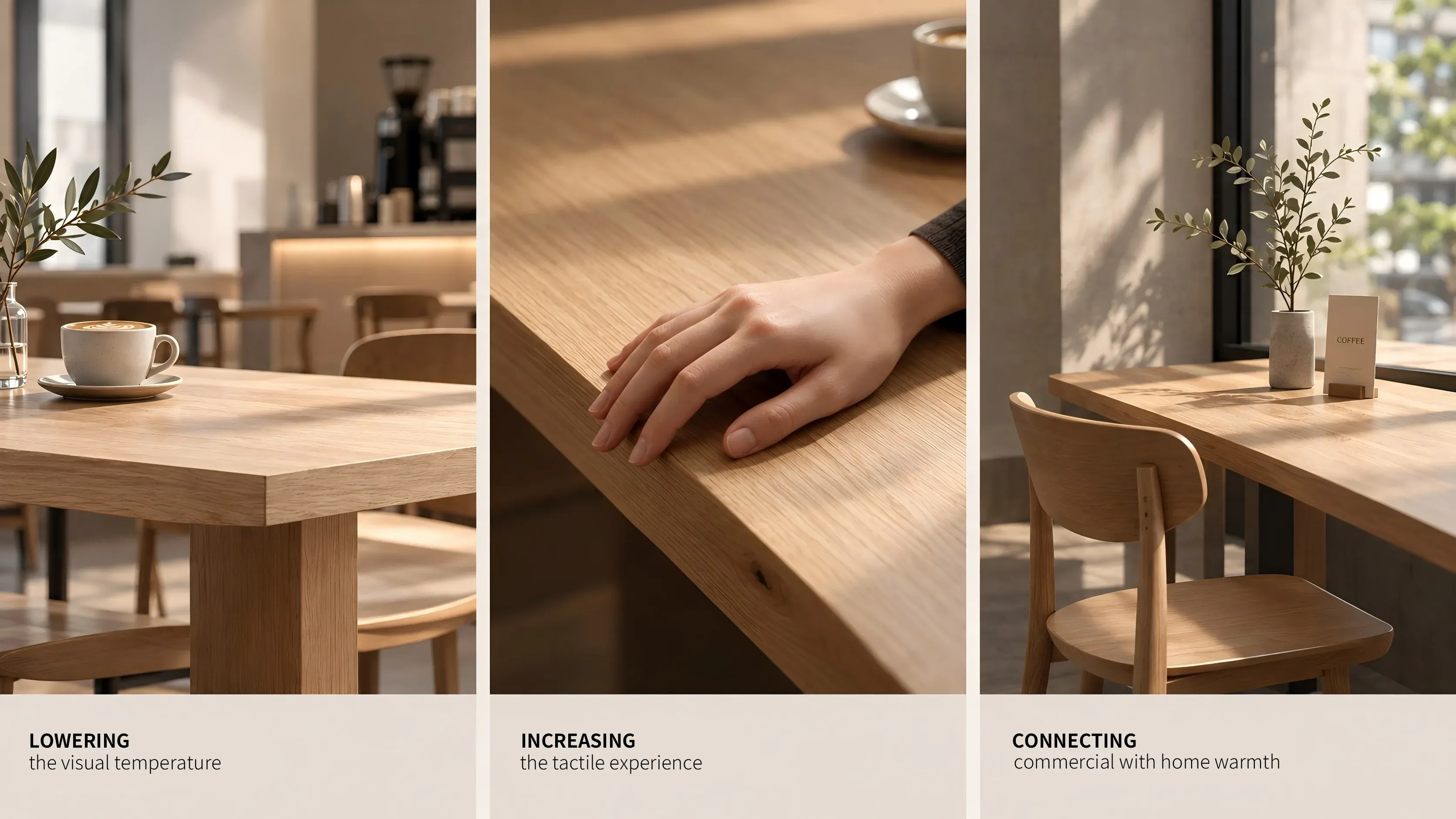
The quiet cafe look depends on restraint. Interiors use fewer materials, softer contrasts, and natural finishes that age gracefully. Wood-grain tops support that logic in three ways.
First, they lower the visual temperature. A pale or mid-tone wood grain keeps a small cafe feeling open and airy. It reflects light without the coldness of a glossy surface, and it does not dominate the room the way a strong pattern or a dark, heavy finish can.
Second, they add tactility without clutter. A quiet interior still needs warmth. A wood-grain surface gives customers something natural to touch - familiar, calm, and visually quiet - without introducing a loud color or a busy pattern.
Third, they bridge commercial and residential cues. Many cafe customers associate wood-grain tables with home kitchens, Scandinavian interiors, and slow mornings. In a commercial setting, that association makes the space feel less transactional and more comfortable.
None of these effects depend on the top being solid white oak, or on a particular whitewash process. They depend on the grain being visible, the tone being calm, and the finish being appropriate for commercial use.
THE GRAIN IS THE AESTHETIC; THE SUBSTRATE IS THE SPECIFICATION
This is the practical distinction that commercial buyers need to keep clear. "Wood-grain tabletop" describes a look. The substrate behind that look can be several different things, and each has different implications for cost, maintenance, and durability.
Solid timber with a hard-wax oil finish. A solid wood top finished with a hard-wax oil such as OSMO gives a natural, open-pored surface with a soft sheen. It feels like real wood because it is real wood. The trade-off is maintenance: hard-wax oil surfaces generally need periodic care, and spills should be wiped promptly rather than left standing. It is a good fit for lower-to-moderate traffic areas, lounges, and spaces where the natural feel is part of the concept.
Engineered wood or veneered tops. These can deliver a consistent wood-grain look across larger sizes with more dimensional stability than solid timber. The specification should state the substrate and the veneer or surface layer clearly, because "wood top" alone does not tell the buyer what is underneath.
Wood-plastic composite (WPC) tops. WPC tops carry a wood-grain surface but are not timber. They are generally more resistant to moisture and easier to wipe clean, which makes them a practical choice for high-traffic cafes, outdoor-adjacent seating, and operators who want the wood look without the maintenance routine of a natural oil finish. The grain pattern is manufactured, so the buyer should confirm the sample and understand that the surface will not age or patina the way solid wood does.
None of these is automatically better. The quiet aesthetic only works commercially when the substrate matches the way the cafe actually operates.
WHY THE FINISH MATTERS AS MUCH AS THE GRAIN
For a commercial table, the finish is where the aesthetic meets daily reality. Two tops can carry the same wood-grain look and behave very differently after a year of coffee spills, cleaning chemicals, and chairs being pulled in and out.
A hard-wax oil finish, such as OSMO, gives a natural matte appearance and a surface that can be maintained rather than simply replaced. It suits spaces where the wood is meant to show character over time. The cafe team needs a simple care routine: wipe spills promptly, avoid harsh cleaners, and plan for periodic re-oiling where the specification calls for it.
A factory-applied lacquer or a WPC surface generally offers a more forgiving routine for high-traffic operations: easier to wipe clean, less sensitive to standing moisture, and less dependent on staff maintenance habits. The visual result can still be calm and natural, but the surface behaves more like a commercial finish than an open-pored timber.
The point is not to recommend one finish over another. The point is that "wood-grain look" should never be ordered from a photo alone. The buyer should confirm the substrate, the finish system, the sheen level, and the approved sample, and should understand what the daily care routine will be.
PAIRING WOOD-GRAIN TOPS WITH COMMERCIAL TABLE BASES
The quiet cafe aesthetic works best when the top and base are chosen together. A calm wood-grain top can soften the visual weight of a cast iron or steel base, while a darker base gives the table definition and keeps it from disappearing into a pale interior.
Common pairings include:
- Wood-grain top with a black cast iron pedestal for a clean, grounded look that suits high-traffic seating.
- Wood-grain top with a brushed stainless or powder-coated steel frame for a brighter, more industrial space.
- Wood-grain top with a slim central column for smaller tables where floor space and sightlines matter.
- Wood-grain top with a four-leg base for a more residential, furniture-like feel in lounges and bakery corners.
The base should be selected for the tabletop size and intended use, not only for the style. A larger top needs a base with enough footprint and stability for the way customers lean, stand, and move chairs. The quiet aesthetic may look effortless, but the stability underneath is not.
Further reading: from pairing to layout
A well-paired table is the starting point. The next decisions sit in the numbers around it - the base that matches the top, the height that fits the chair, the chairs that fit the table, and the footprint that makes a small room work.
- Choosing the Right Table Base for Your Table Top: Stability, Style, and Size - a practical guide to matching base type, material, and footprint to the top it carries, with inch and millimeter references.
- Commercial Table Height Guide for Cafe, Bistro & Restaurant Standards - standard heights, seat-to-table clearance, and the 10–12 inch rule that keeps a table comfortable in daily use.
- How Many Chairs Fit at Your Table? A Complete Sizing Guide - chair counts for round, square, and rectangular tops, from 600 mm to 1500 mm, so the pairing matches the seating plan.
- Best Table Base and Top Sets for Small Commercial Spaces - compact base-and-top combinations for cafes, bistros, and narrow rooms where floor area and chair tuck-in matter.
WHAT TO CONFIRM BEFORE SPECIFYING A WOOD-GRAIN TOP
Wood-grain surfaces vary - by substrate, by finish, and by batch. That variation is part of the appeal, but it also means commercial buyers should confirm a few practical points before placing an order.
Confirm the substrate, not just the look. Ask whether the top is solid timber, engineered wood, veneered, or WPC. Each has different maintenance and durability implications, and the quotation should state the material clearly.
Confirm the finish system and care routine. Ask how the surface should be cleaned, what should be avoided, and whether the finish can be maintained or repaired locally. A hard-wax oil finish and a factory lacquer or WPC surface require different routines, and the cafe team should know which one applies.
Confirm the sample in natural light. Ask for a physical sample or detailed close-up photos of the actual finish. Check the tone and grain in natural light, not only under showroom lighting.
Confirm batch consistency expectations. Natural timber and manufactured wood-grain surfaces both vary. The question is how the supplier manages that variation and whether the approved sample is used as the reference for the order.
Confirm the base pairing. A calm wood-grain top can make a heavy base feel lighter, but it can also make an undersized base look more obvious. Confirm that the base is appropriate for the top size and the seating layout.
THE QUIET AESTHETIC IS A SPECIFICATION DECISION
The "quiet cafe" look appears simple because it removes visual noise. In practice, it depends on careful material choices: a calm grain, a finish that suits commercial cleaning, a base that grounds the table without dominating it, and a sample that both the buyer and the supplier agree on.
Wood-grain tops are defining this aesthetic because they offer warmth, texture, and restraint in one surface - whether the substrate is solid timber finished in hard-wax oil, engineered wood, or a wood-plastic composite. For commercial projects, the challenge is to keep that calm look consistent across a full order, not just in a single sample. That is where clear specifications, approved samples, and practical base pairing matter more than the trend itself.
ABOUT VVITAL
VVITAL supplies commercial table bases and tops for hospitality projects, working with long-term manufacturing partners on production, finishing, and quality coordination. Product specifications, samples, lead times, and warranty terms are confirmed per order.
PLANNING A COMMERCIAL PROJECT?
Share your tabletop size, finish preference, and base pairing requirements, and our team will help you confirm the right wood-grain tabletop specification before you order. We can advise on substrate and finish options, coordinate samples, and confirm lead times and warranty terms per order.
Email us directly at vip@vvitablebases.com with your tabletop size and preferred finish, and we will reply with specification advice, sample options, and lead time.
Email the VVITAL Team Browse commercial table bases and tops
Reviewed by the VVITAL Product Team. Specifications, samples, lead times, and warranty terms are confirmed per order.