
Replacing Table Tops Without Replacing Bases: A Smart Maintenance Guide
Save costs by replacing only commercial table tops while keeping your bases. Learn fixing methods: pre-embedded inserts, grooves, and MDF substrates.

REPLACING TABLE TOPS WITHOUT REPLACING BASES: A PRACTICAL MAINTENANCE TIP
Commercial table tops usually wear out before the bases do. The top takes the daily impact—plates, glassware, cleaning chemicals, hot dishes and constant wiping—while the base mainly carries vertical load. If the base is still stable and structurally sound, replacing only the top can be a practical maintenance option rather than a full furniture replacement.
QUICK CHECK: IS YOUR BASE REUSABLE?
Use this checklist before deciding to keep a base:
- The base sits flat and does not wobble on the actual service floor.
- Levelling feet are present and adjustable.
- The top support plate is firmly fixed, with no deformation, cracks or loose screws.
- Fixing method can be reproduced to match the base's top support plate (via pre-embedded inserts, grooved slots, or an added MDF substrate).
- The base's footprint and load rating suit the replacement top's size, thickness and material.
- The finished table height still fits the seating and service style.
- The base's appearance is acceptable, or can be refurbished (repaint, new feet).
- The replacement top will visually match adjacent tables.
If the base rocks after adjustment, shows corrosion at threaded points, has a flexing or deformed top support plate, is undersized for a heavier top, or no longer gives the correct height, replace the base instead. A new top on a failing base is a delayed failure.
CHECKS BEFORE ORDERING
1. Dimensions and Load
Confirm the top's shape, length or diameter, and thickness. Check the base footprint, column size and rated load—especially for stone or compact laminate tops. Confirm the finished height from floor to top surface, not just the top thickness.
2. Top Support Plate and Hole Pattern
Do not rely on the old top's screw holes—they may have been drilled off-centre or modified. Confirm the base's top support plate size, hole spacing, thread size, and insert depth.
Key measurements to record:
- Top support plate length × width
- Hole spacing (centre-to-centre)
- Hole diameter / thread size
- Insert depth or MDF substrate thickness
- Grooved slot position and direction (if applicable)
- Finished table height
3. Fixing Methods: Inserts, Grooves, or MDF Substrate
To match retained bases, replacement tops can be manufactured using three main fixing methods:
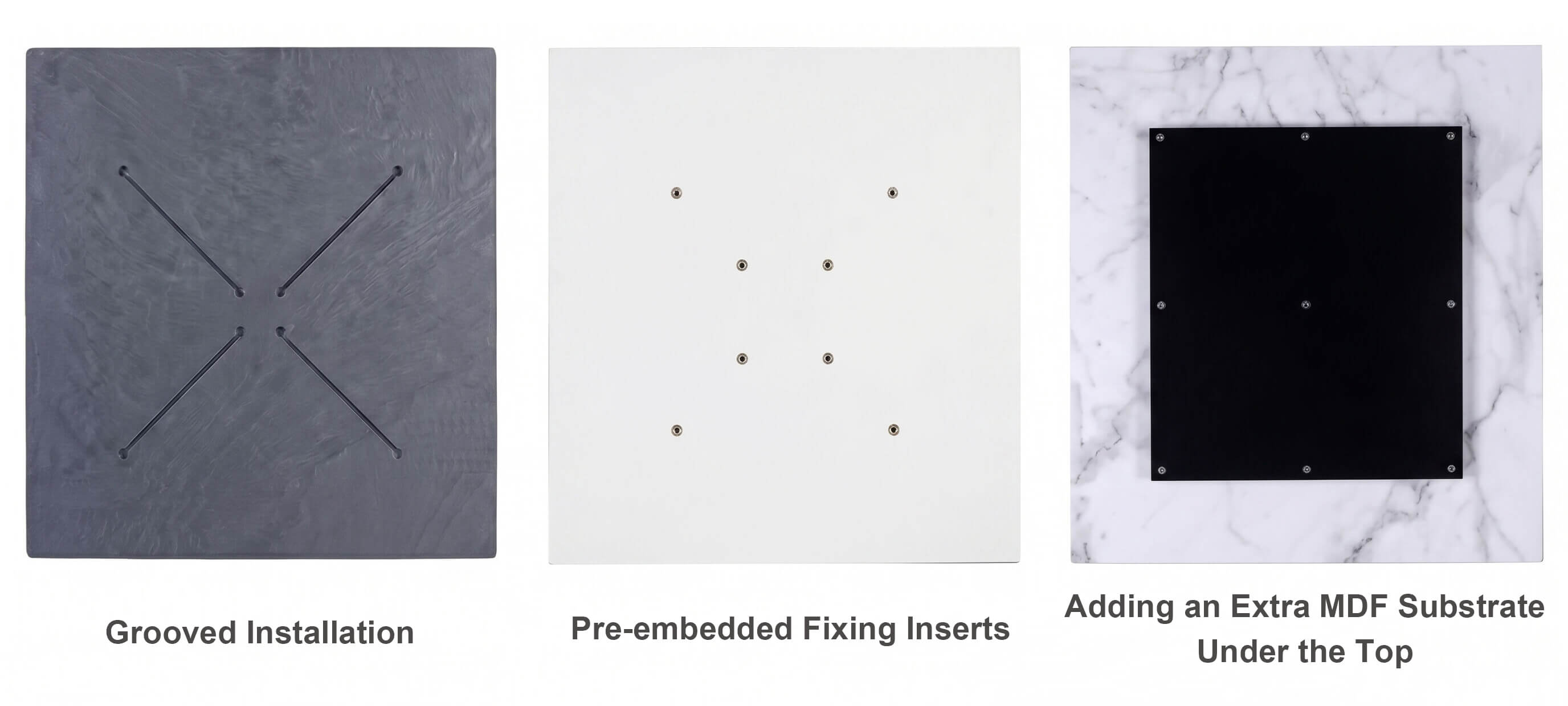
- Pre-embedded Fixing Inserts: Threaded inserts are embedded directly into the underside of the top (ideal for compact laminate or solid wood). Screws pass through the base plate into the inserts.
- Grooved Installation: Slots are routed into the underside of the top. This is often used for solid wood to allow for seasonal movement while holding the top securely.
- Adding an Extra MDF Substrate Under the Top: An MDF board is bonded to the underside of the top (commonly used for stone, ceramic, or thinner surfaces). This provides a stable, thicker layer for drilling and screw fixing, prevents the hard surface from cracking, and allows for flexible hole placement.
Note: Screw length must suit the top's thickness and the specific fixing method used. Over-long screws can damage the surface.
4. Material-to-Base Matching
| Top Material | What to Check |
|---|---|
| HPL / Compact Laminate | Edge sealing, insert depth, screw length |
| Sintered Stone / Marble / Terrazzo | Weight; base load rating; highly recommend adding an MDF substrate |
| Solid Wood | Seasonal movement; slotted fixings (grooves) |
| Other Engineered Stones | Hole processing and screw length; MDF substrate recommended |
5. Budget and Design Consistency
Top-only replacement normally costs less than buying complete tables and avoids the base's material, finishing and freight cost. For multi-room venues, phase replacement by zone and keep spare tops for high-wear areas.
Match the replacement top's thickness, edge profile and finish to adjacent tables. A visibly thicker or thinner top disrupts the room even when the surface colour is correct. If an MDF substrate is added, account for its thickness in the final table height.

COMMON MISTAKES
- Measuring only the top diameter, not the top support plate hole pattern.
- Changing top thickness (or adding an MDF board) but keeping the original screw length.
- Using an undersized base for a heavier stone or compact laminate top.
- Ordering from the old top's holes after they have been modified.
- Replacing the top while the base already wobbles.
FAQ
Can I replace only the table top and keep the base?
Yes, if the base is stable, structurally sound, correctly sized for the new top, and its fixing pattern can be reproduced.
What fixing methods do you offer for replacement tops?
We offer pre-embedded fixing inserts, grooved installation, and the option of adding an extra MDF substrate under the top for secure, flexible screw fixing.
Why should I add an MDF substrate under my table top?
It is highly recommended for stone, ceramic, or thin tops. The MDF provides a reliable layer for screw fixing, prevents the top material from cracking, and gives more flexibility for matching the base's hole pattern.
How do I confirm the hole pattern?
Measure the base's top support plate—not the old top's screw holes—including plate size, hole spacing, and thread size.
What if my base is wobbly?
Check the levelling feet first. If the wobble persists, or the top support plate is deformed or rusted, replace the base rather than fitting a new top.
Do you offer OEM replacement tops?
Yes. VVITAL produces commercial table bases and tops as coordinated components and supports OEM replacement tops to retained base specifications.