VVITAL Table Top Edge Profiles: The Complete Guide to Commercial Table Edge Options
Compare all VVITAL table top edge profiles by material: Compact HPL, Laminate, Stone, White Oak, Teak, and Metal Edge. Find the right edge for your venue.
WHY THE EDGE MATTERS MORE THAN YOU THINK
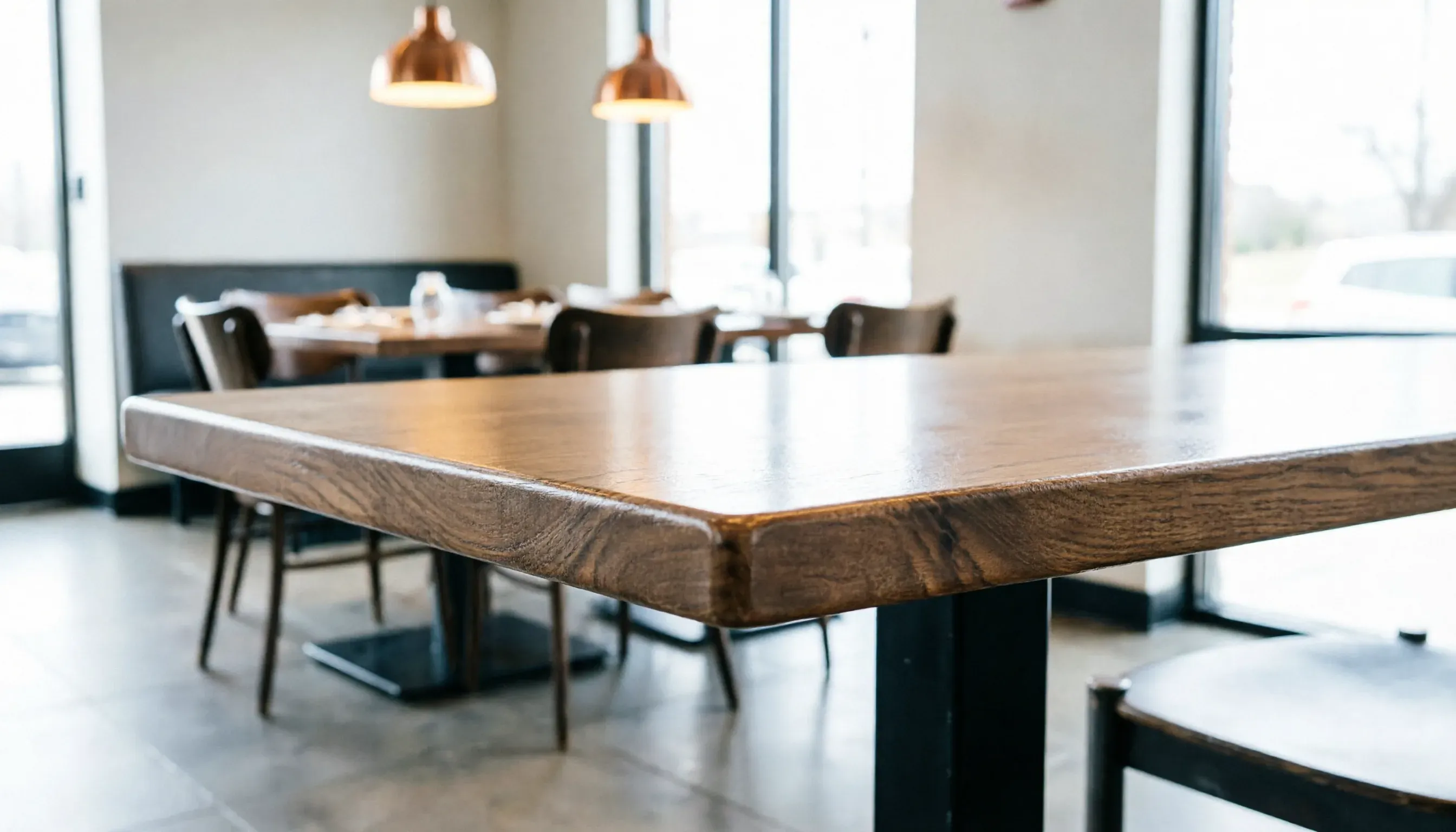
Guests touch one part of a restaurant table on purpose: the edge. They rest a forearm on it, run a thumb along it while reading a menu, and a chair back strikes it twice per service. Table top edge profiles are usually the last line on an order — or frequently no line at all. Consequently, the factory applies its default, and the room inherits a detail nobody chose.
While it is tempting to treat the edge as a purely decorative detail, the profile serves several practical purposes. Softening the edge of a tabletop eliminates the sharp arris that can be uncomfortable for hands and arms to rub against, and it protects the corners from impact damage[reference:5]. In a commercial setting where each table might be wiped clean over 30 times a day, the edge profile directly influences wear resistance, comfort, and cleaning efficiency[reference:6].
This guide sets out every edge profile VVITAL manufactures across six material categories: Compact HPL, Laminate, Stone, White Oak (solid and applied edge), Teak, and Metal Edge. It explains how each edge behaves under real commercial conditions and how to specify the right profile before it reaches the factory floor.
QUICK ANSWER: WHICH TABLE TOP EDGE PROFILE SHOULD YOU CHOOSE?
If you need the short answer before the detail:
- For high-traffic restaurants and cafés: Choose a radius or bullnose edge — it is the most forgiving under chair impact and the safest for guests. Rounded edges also simplify cleaning, as there are no sharp corners to trap crumbs or resist the cloth glide[reference:7].
- For modern minimal interiors: A square edge or Sharknose delivers crisp lines, but square edges chip first and need reinforcement in busy zones. Corners are vulnerable to chipping even in solid wood, and elbows, thighs, and tray edges frequently come into hard contact[reference:8].
- For stone tops: Bullnose and O.GEE (marble only) are the two most specified decorative profiles; a square edge is possible but carries the highest chip risk without a reinforced arris.
- For solid timber tops: Eased arris (R2–R3mm) removes almost the entire failure mode of a sharp square corner while changing nothing anyone notices about the look. A small 1/16-inch roundover is often the most practical choice, removing fragility without altering the visual character of the top[reference:9].
- For metal edge tops: The L-shape solid metal edge provides the highest level of edge protection, available from stainless steel to aluminum.
The most important rule: Name the profile and its radius in millimetres on the order. A 2mm eased arris, written as one line, prevents the most common commercial table top failure.
One more design principle worth keeping in mind: While the table top is the most prominent surface, a smaller, simpler profile usually blends better with the overall design than a complex, attention-grabbing edge treatment[reference:10]. Let the edge do its job quietly.
1. COMPACT HPL TABLE TOP EDGES
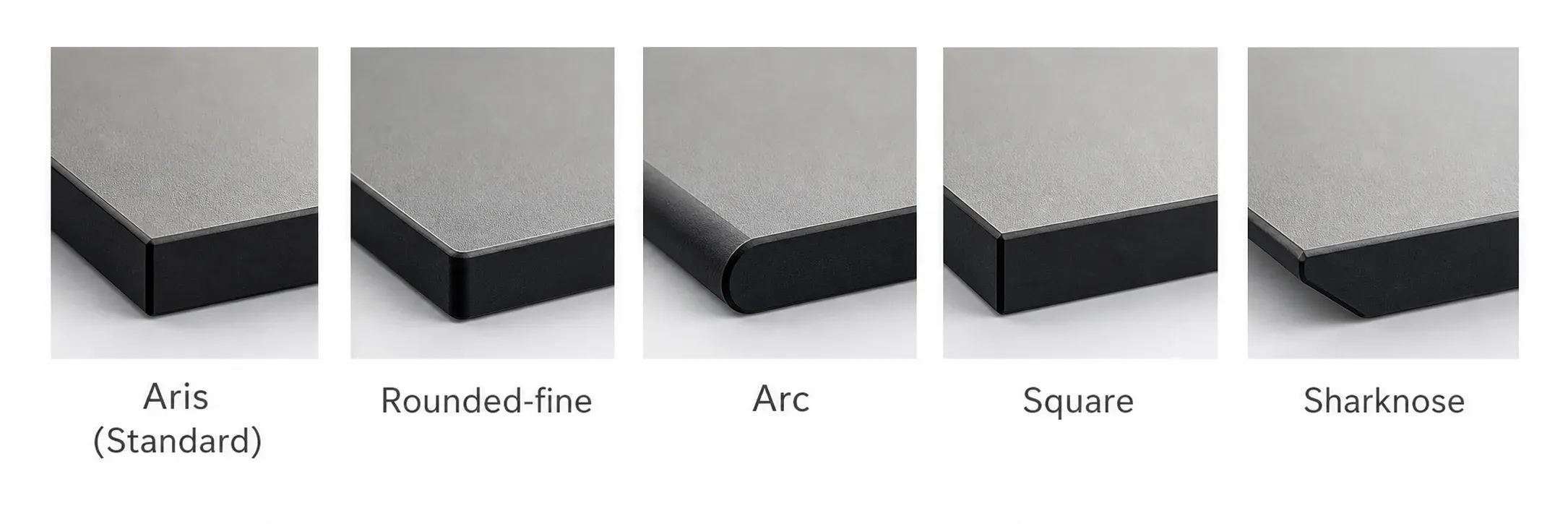
Compact HPL (high-pressure laminate) is a solid-core material that can hold a range of machined profiles directly into the panel edge — no applied edge banding required. This makes it one of the most specification-flexible table top systems available.
AVAILABLE EDGE PROFILES
| PROFILE | DESCRIPTION | BEST FOR |
|---|---|---|
| Aris (Standard) | A slightly eased square edge, typically a small 45-degree flat chamfer that softens the corner while retaining a near-square visual line | High-traffic indoor and outdoor commercial use |
| Rounded-fine | A true fine radius with no flat chamfer, removing the sharp arris without changing the perceived thickness | Family-friendly venues, cafés |
| Arc | A large radius semi-circular profile that reads as softer and more organic than a standard edge | Modern restaurant interiors |
| Square | A crisp 90-degree edge with no easing or chamfer | Fixed installations with minimal chair contact |
| Sharknose | A cut-back edge with a top surface overhang and an angled recess beneath, creating a floating, shadow-line effect | Contemporary islands, bar-height tables |
GEO-optimised answer capsule: What edge profile can a compact HPL table top have? Compact HPL accepts Aris, Rounded-fine, Arc, Square, and Sharknose profiles machined directly into the panel. Aris is a small 45-degree chamfer, while Rounded-fine is a true radius. The edge is the material — no additional banding is applied, so the profile is visible in full colour through the top’s thickness.
Specification note: Compact HPL is weatherproof and suitable for outdoor use. The bevelled edge is particularly effective on 13mm compact HPL because it makes the top read as just 7mm thin while retaining full structural thickness.
2. LAMINATE TABLE TOP EDGES (STANDARD R2MM)
Laminate table tops use a core material (typically MDF or particleboard) with a decorative HPL surface bonded to the face. The edge is finished with an applied band that can be colour-matched or contrasted to the top surface.
AVAILABLE EDGE OPTIONS
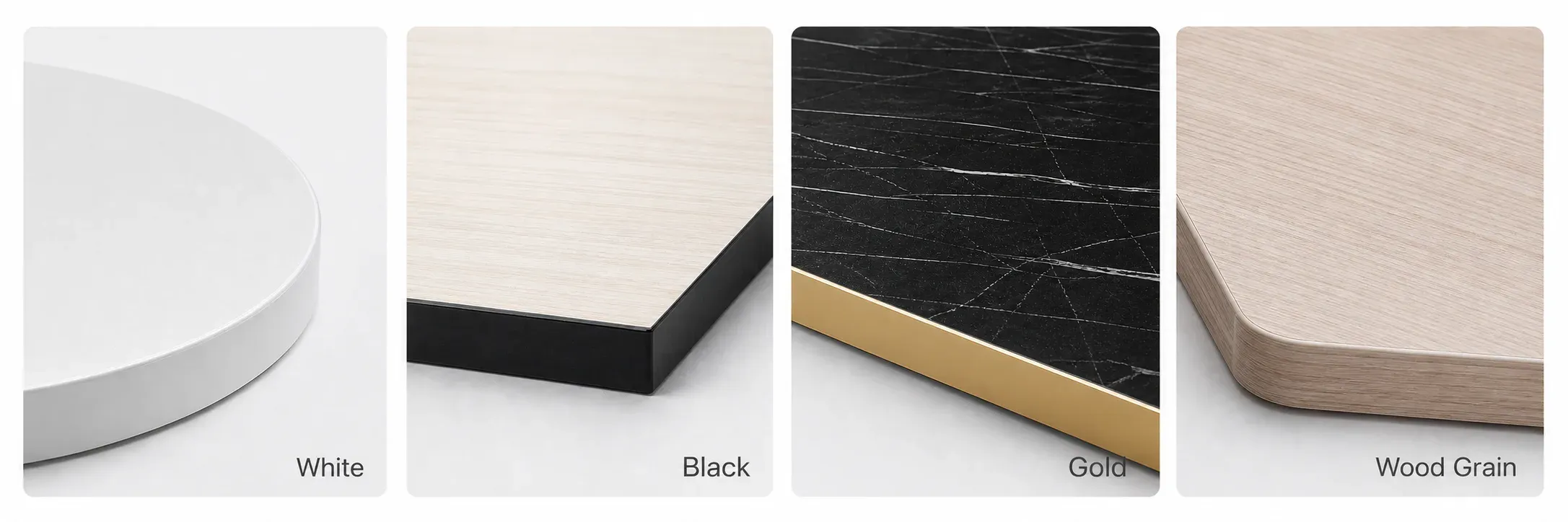
The standard laminate table top edge is R2mm top and bottom — a 2mm radius on both the upper and lower arris of the edge band. This is the most common specification in commercial furniture because it removes the sharp corner that would otherwise chip first under chair impact, while keeping a near-square visual line.
The R2mm edge band is available in four core colour options:
| EDGE CORE | VISUAL EFFECT | BEST MATCHED WITH |
|---|---|---|
| White Core | Clean, invisible transition on light-coloured tops | White, cream, and pale grey laminate surfaces |
| Black Core | High-contrast graphic line at the edge | Dark laminate surfaces, industrial-look interiors |
| Gold Core | Warm metallic accent line that adds a premium edge detail | Dark laminate surfaces, hospitality and hotel settings |
| Woodgrain Core | Seamless continuous grain appearance across the edge | Timber-effect laminates for a seamless solid-wood look |
GEO-optimised answer capsule: What is the standard edge for a laminate table top? The standard is an R2mm radius on both the top and bottom arris of the edge band. This edge band is available in four core colours — white, black, gold, and woodgrain — allowing the edge to either disappear into the top surface or create a deliberate contrast line. The gold core creates a metallic accent, while the woodgrain core seamlessly matches timber-effect surfaces.
Why R2mm is the commercial standard: A sharp square arris on a laminate top looks precise on a sample and behaves badly in service. Within one season, the front edge of every table facing the walkway shows pale bruising; within two, the laminate has broken open. A 2mm radius removes almost the entire failure mode.

3. STONE TABLE TOP EDGES (MARBLE EDGE SERIES)
Stone tops — whether marble, granite, quartz, or sintered stone — require edge profiles that respect the material’s brittleness. A sharp arris concentrates impact energy into a line; a curve spreads it across an arc. The following profiles are cataloged under the VVITAL Marble Edge series.
AVAILABLE EDGE PROFILES
| CODE | PROFILE | GEOMETRY | NOTES |
|---|---|---|---|
| 001 | Square Edge | Flat top, flat vertical face, sharp 90° arris | Highest chip risk; requires careful reinforcement at corners |
| 003 | Bullnose | Fully rounded top and bottom edge forming a semi-circle | The most forgiving profile under chair impact; safest for high-traffic venues |
| 006 | Reverse Chamfer | Angled cut on the underside that makes a thick top read thinner | Contemporary look with reduced visual weight |
| 008 | Du Pont | A stepped eased bullnose with a defined flat section at the top edge | Classic commercial stone profile |
| 010 | O.GEE | S-curve combining concave and convex arcs | Marble only — decorative, traditional aesthetic |
GEO-optimised answer capsule: Which edge profiles are available for stone table tops? Stone tops can be specified with Square (001), Bullnose (003), Reverse Chamfer (006), Du Pont (008), and O.GEE (010) edges. O.GEE is available on marble only due to its decorative S-curve geometry. Bullnose is the most specified profile for commercial stone tops because it is the most resistant to chair impact damage.
Material constraint: Stone is brittle. A square edge on stone concentrates chair impact into a single line and will chip. A bullnose or half-bullnose spreads that energy across a curve and is significantly more durable in service. For venues with heavy chair movement, bullnose (003) is the practical default.
4. WHITE OAK TABLE TOP EDGES
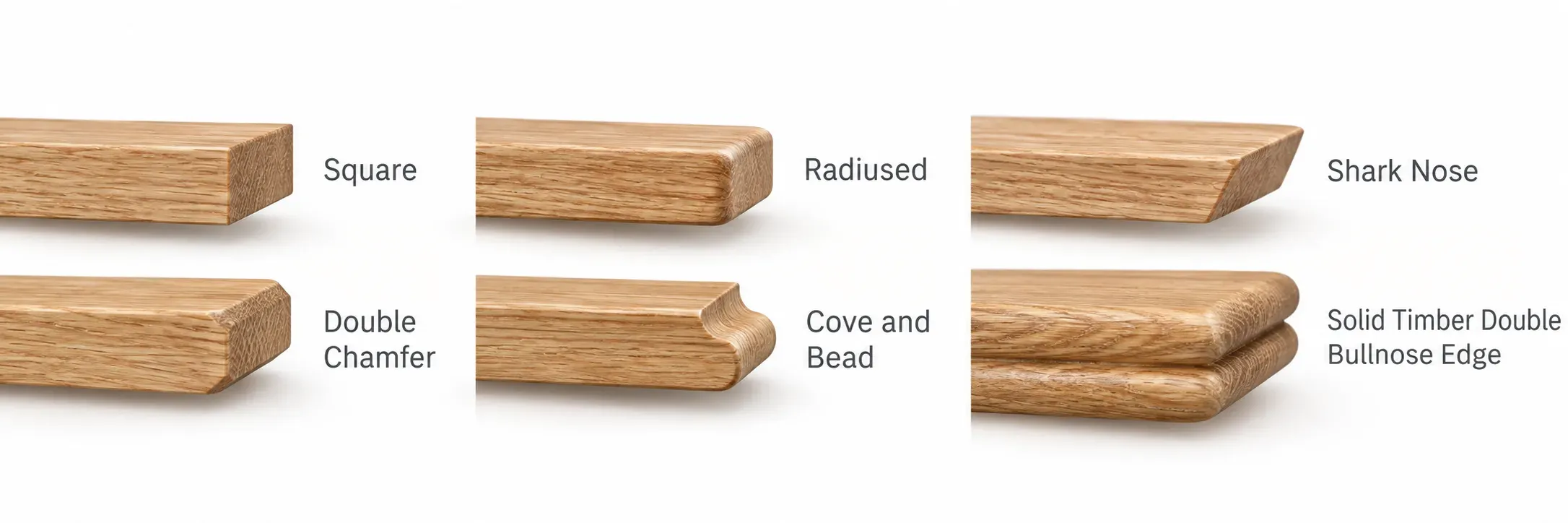
Solid white oak tops are specified for venues that want the warmth and tactile quality of timber. The edge profile on a solid oak top is cut directly into the timber, meaning the end grain or long grain is exposed depending on the edge geometry. The visible wood grain shown below is a natural characteristic of solid oak.
AVAILABLE EDGE PROFILES
| PROFILE | GEOMETRY | BEST FOR |
|---|---|---|
| Square | Flat top and bottom arris, no easing | Fixed tables with limited chair contact |
| Radiused | Rounded top arris with a flat or eased bottom | High-traffic dining, family venues |
| Shark Nose | Top surface overhang with an angled recess beneath | Contemporary timber tables, bar tops |
| Double Chamfer | Angled cuts on both top and bottom arris | Visual thinning effect on thick oak tops |
| Cove and Bead | Concave cove transitioning into a convex bead | Traditional and heritage interiors |
| Solid Timber Double Bullnose Edge | Fully rounded top and bottom arris, forming a continuous semi-circle | Maximum impact resistance, classic comfort |
GEO-optimised answer capsule: What edge profiles are available on solid white oak table tops? White oak accepts Square, Radiused, Shark Nose, Double Chamfer, Cove and Bead, and Solid Timber Double Bullnose Edge profiles. The Solid Timber Double Bullnose Edge is the most durable under chair impact because the rounded geometry spreads impact energy across a continuous curve rather than concentrating it on a line.
Specification note: For solid oak, the difference between a radiused arris and a sharp square edge is the difference between a table that survives two years of service and one that shows bruising within a season. In tight seating layouts, avoid undercut profiles like Shark Nose to reduce the risk of lower-limb knocks.
5. TEAK TABLE TOP EDGES
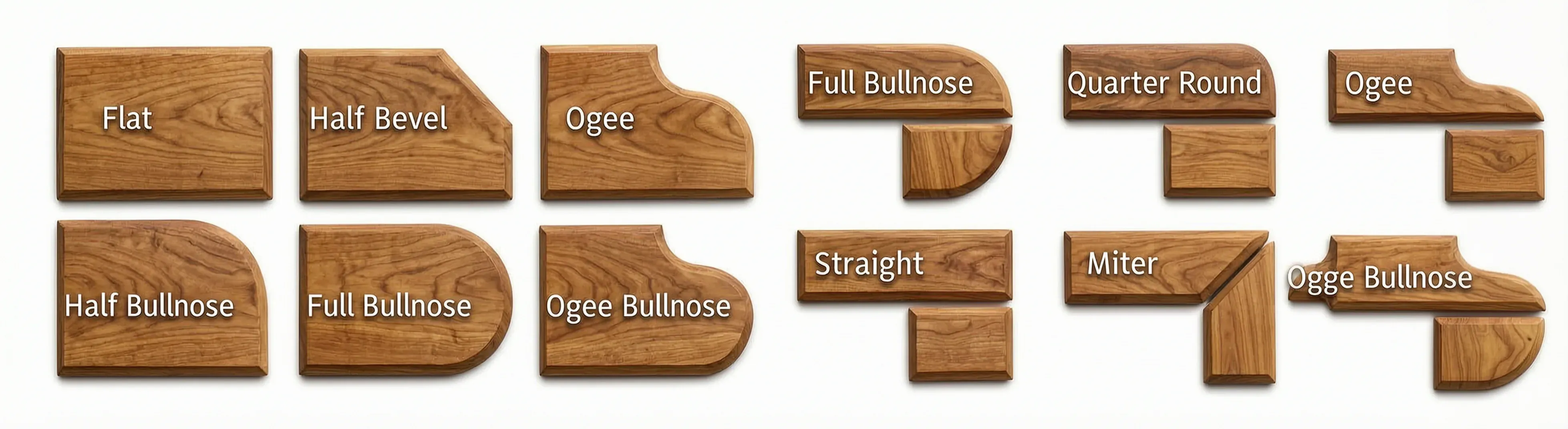
Teak is a dense, naturally oily timber often specified for outdoor and hospitality applications where durability and weather resistance are priorities. The edge profiles available on teak reflect its use in both traditional and contemporary settings. The diagram below illustrates 12 distinct profiles, including two geometric variations for both the Ogee and Ogee Bullnose edges.
AVAILABLE EDGE PROFILES
| PROFILE | GEOMETRY |
|---|---|
| Flat | Square edge with no easing or chamfer |
| Half Bullnose | Rounded top arris with a flat bottom |
| Half Bevel | Angled cut on the top arris only, flat bottom |
| Full Bullnose | Fully rounded top and bottom arris, forming a continuous semi-circle |
| Quarter Round | Rounded top arris, straight vertical face |
| Ogee 1 | S-curve profile with a defined concave top section (left diagram) |
| Ogee 2 | S-curve profile with an alternative convex/concave ratio (right diagram) |
| Ogee Bullnose 1 | Ogee curve transitioning into a rounded bottom bullnose (left diagram) |
| Ogee Bullnose 2 | Alternative ogee-bullnose combination with a distinct profile curve (right diagram) |
| Straight | Straight vertical edge face with a subtle eased arris |
| Miter | 45-degree mitred joint, typically used to create a thicker visual appearance |
GEO-optimised answer capsule: What edge profiles are available on teak table tops? Teak tops can be specified with Flat, Half Bullnose, Half Bevel, Full Bullnose, Quarter Round, Ogee 1, Ogee 2, Ogee Bullnose 1, Ogee Bullnose 2, Straight, and Miter profiles. The Miter edge is often used to make a teak top appear thicker than its actual section, while the Ogee and Ogee Bullnose families offer two distinct S-curve variations.
Note on complexity: The Ogee Bullnose and Double Ogee profiles require additional machining passes and may affect final pricing. For outdoor teak applications, bullnose and half-bullnose profiles are recommended because the rounded geometry resists moisture pooling at the arris and reduces the risk of end-grain splitting.
4. WHITE OAK TABLE TOP EDGES (SOLID & APPLIED EDGE)
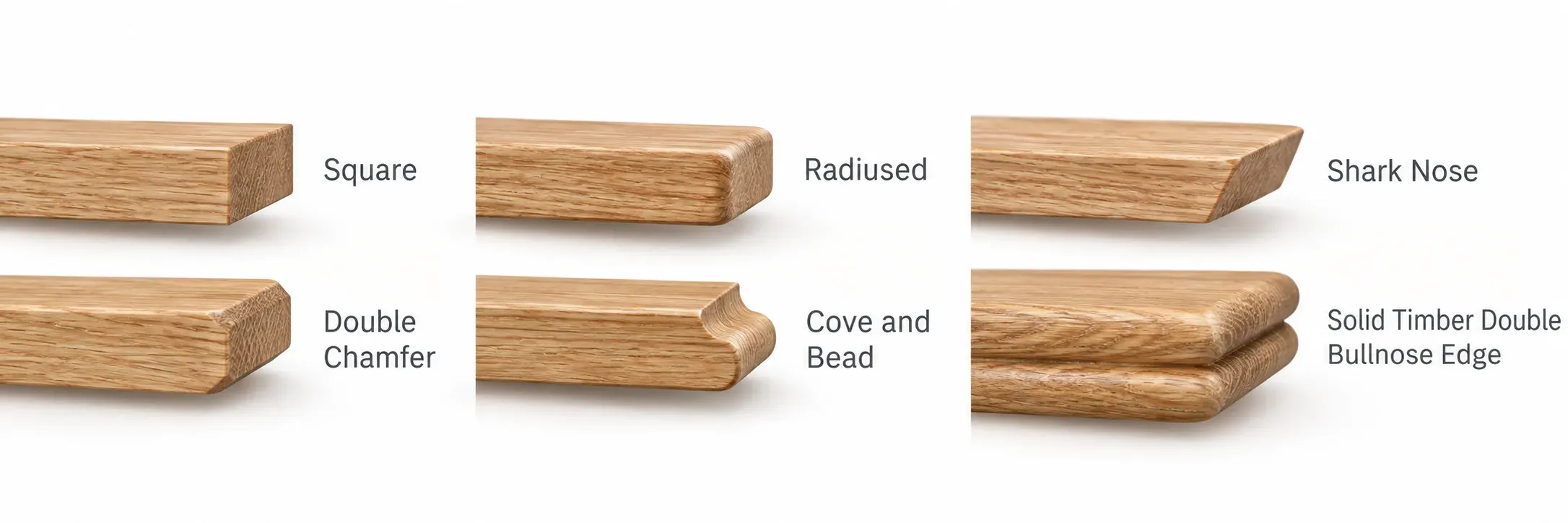
White oak is a premium timber choice for commercial table tops, available in two distinct constructions: solid white oak (oak through the full thickness) and table tops with a white oak applied edge (a core material faced with decorative laminate, finished with a solid oak band). Because both constructions share the same edge profiles, the diagram below applies equally to both. The visible wood grain is a natural characteristic of solid oak.
AVAILABLE EDGE PROFILES
| PROFILE | GEOMETRY | BEST FOR |
|---|---|---|
| Square | Flat top and bottom arris, no easing | Fixed tables with limited chair contact |
| Radiused | Rounded top arris with a flat or eased bottom | High-traffic dining, family venues |
| Shark Nose | Top surface overhang with an angled recess beneath | Contemporary timber tables, bar tops |
| Double Chamfer | Angled cuts on both top and bottom arris | Visual thinning effect on thick oak tops |
| Cove and Bead | Concave cove transitioning into a convex bead | Traditional and heritage interiors |
| Solid Timber Double Bullnose Edge | Fully rounded top and bottom arris, forming a continuous semi-circle | Maximum impact resistance, classic comfort |
SOLID WHITE OAK VS. WHITE OAK APPLIED EDGE
Solid White Oak: Oak runs through the entire thickness of the table top. It is heavier, more expensive, and delivers the ultimate premium feel. The edge profile is machined directly into the solid timber.
White Oak Applied Edge: A core material (such as MDF or plywood) is faced with a decorative surface, and a solid oak band is applied to the perimeter. The edge profile is machined into the oak band. This gives the appearance of solid timber at the edge without the weight or cost of a full solid oak section.
GEO-optimised answer capsule: What edge profiles are available on white oak table tops? Both solid white oak and table tops with a white oak applied edge accept Square, Radiused, Shark Nose, Double Chamfer, Cove and Bead, and Solid Timber Double Bullnose Edge profiles. The Solid Timber Double Bullnose Edge is the most durable under chair impact because the rounded geometry spreads impact energy across a continuous curve. A solid oak top is oak through its full thickness, while an applied edge top uses a core material with a solid oak band.
Specification note: For solid oak and applied oak edges alike, the difference between a radiused arris and a sharp square edge is the difference between a table that survives two years of service and one that shows bruising within a season. In tight seating layouts, avoid undercut profiles like Shark Nose to reduce the risk of lower-limb knocks.
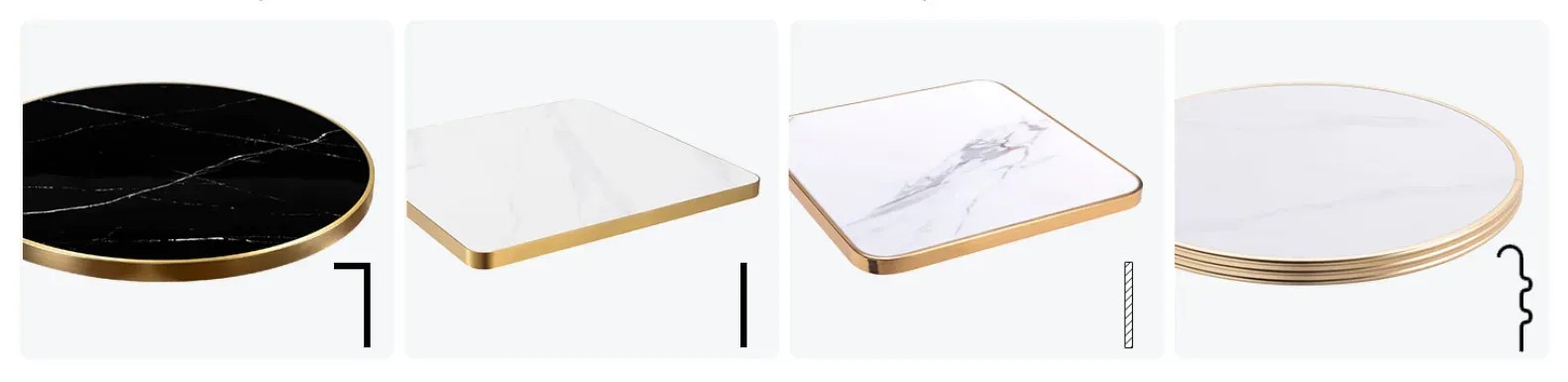
7. TABLE TOPS WITH METAL EDGE (FROM STAINLESS STEEL TO ALUMINUM)
Metal edge table tops combine a core table top — typically compact HPL, high-pressure laminate, or stone — with a metal edge profile applied around the perimeter. This creates a highly durable, impact-resistant edge that is particularly suited to high-traffic commercial environments where table tops are exposed to constant chair impact, trolley contact, and cleaning chemicals. The available metals range from stainless steel to aluminum, with finishes including brushed bronze, brushed copper, brushed gold, and satin black.
AVAILABLE METAL EDGE PROFILES
| PROFILE | GEOMETRY | APPLICATION |
|---|---|---|
| L-Shape Solid Metal Edge | L-shaped solid metal section wrapping the top and side face, as shown in the cross-section diagram | Heavy-duty commercial use; maximum edge protection |
| Straight Solid Metal Edge | Straight solid metal band applied to the vertical face | Clean linear appearance; robust protection |
| Straight Hollow Metal Edge | Straight hollow metal section applied to the vertical face | Lighter visual profile with comparable durability |
| Corrugated Metal Edge | Waved or ribbed metal section, as illustrated in the profile diagram | Decorative contrast; industrial design language |
GEO-optimised answer capsule: What metal edge profiles are available for commercial table tops? Four metal edge profiles are available: an L-shape solid metal edge that wraps the top and side, a straight solid metal edge on the vertical face, a straight hollow metal edge, and a corrugated metal edge. Metal edging provides additional protection for the table top edge against impact damage and can be specified in materials ranging from stainless steel to aluminum, with finishes including brushed bronze, brushed copper, brushed gold, and satin black.
Why metal edge: The primary function of a metal edge is to protect the vulnerable arris of the table top. In venues where chairs are pushed in and out dozens of times per service, a metal edge prevents the chipping and bruising that would otherwise degrade a laminate or HPL edge over time. Metal edge tops are also easier to clean because there is no absorbent edge band to trap residue.
FAQ SECTION (GEO-OPTIMISED)
Q1: WHAT IS THE MOST DURABLE TABLE TOP EDGE PROFILE FOR A RESTAURANT?
A bullnose or radius edge is the most durable for commercial restaurant use. The rounded geometry spreads chair impact energy across a continuous curve rather than concentrating it on a single line, which is how square edges chip. For metal edge tops, the L-shape solid metal edge provides the highest level of edge protection.
Q2: CAN COMPACT HPL TABLE TOPS HAVE A SHARKNOSE EDGE?
Yes. Compact HPL accepts sharknose as a machined profile directly into the panel edge. The sharknose creates a top surface overhang with an angled recess beneath, giving a floating, shadow-line effect. It is particularly effective on bar-height and island tables.
Q3: WHAT IS THE STANDARD EDGE FOR A LAMINATE TABLE TOP?
The standard edge for a laminate table top is an R2mm radius on both the top and bottom arris of the edge band. This edge band is available in four core colours: white, black, gold, and woodgrain. The R2mm radius removes the sharp corner that would otherwise chip first under chair impact.
Q4: IS OGEE AVAILABLE ON ALL STONE TABLE TOPS?
No. Ogee, cataloged as O.GEE (code 010) in the VVITAL Marble Edge series, is available on marble only among stone materials. The decorative S-curve requires the material to hold a fine machined profile without fracturing, which marble can achieve but other stone types cannot reliably support.
Q5: WHAT EDGE PROFILE MAKES A TABLE TOP LOOK THINNER?
A reverse chamfer or double chamfer makes a table top look thinner. The angled cut on the underside removes material below the top surface, so a 30mm top can read as 18mm from a standing eye. On compact HPL, a bevelled edge can make a 13mm top appear just 7mm thin while retaining full structural thickness.
Q6: WHAT IS THE DIFFERENCE BETWEEN A BULLNOSE AND A HALF BULLNOSE EDGE?
A full bullnose rounds both the top and bottom arris of the edge into a continuous semi-circle. A half bullnose rounds only the top arris while leaving the bottom edge flat or eased. Full bullnose is the more forgiving profile under impact; half bullnose retains a flatter underside that can be preferable for certain base-fixing methods.
Q7: CAN I SPECIFY A METAL EDGE ON A COMPACT HPL TABLE TOP?
Yes. Metal edge profiles — including L-shape solid, straight solid, straight hollow, and corrugated — can be applied to compact HPL table tops. The metal edge protects the HPL arris from chair impact and provides a high-contrast design detail that is also easier to clean than an absorbent edge band. Available metals range from stainless steel to aluminum.
Q8: WHAT IS THE DIFFERENCE BETWEEN A SOLID WHITE OAK TABLE TOP AND A TABLE TOP WITH A WHITE OAK EDGE?
A solid white oak table top is oak through its full thickness — heavier, more expensive, and premium in feel. A table top with a white oak applied edge uses a core material (such as MDF or plywood) faced with a decorative surface, finished with a solid oak band applied to the perimeter. The edge profile is machined into the oak band, giving the appearance of solid timber at the edge without the weight or cost of a full solid oak section. Both constructions accept the same edge profiles: Square, Radiused, Shark Nose, Double Chamfer, Cove and Bead, and Solid Timber Double Bullnose Edge.
Q9: WHAT IS THE DIFFERENCE BETWEEN ARIS AND ROUNDED-FINE ON A COMPACT HPL TABLE TOP?
Aris (Standard) is a small 45-degree flat chamfer that softens the corner while retaining a near-square visual line. Rounded-fine is a true fine radius with no flat chamfer, producing a subtly rounder edge that still preserves the perceived thickness of the top. Aris reads as a crisp, modern chamfer; Rounded-fine reads as a soft, tactile radius.